



Use cloud-based workforce planning tools to visualize staffing trends, monitor performance, and simulate scenarios for faster, more strategic talent planning.
In this modern business environment where everything happens so quickly, achieving objectives is no longer just a function of providing the best services, but also having the right people in the right roles at the right time. That is where manpower planning is necessary.
Manpower planning is essential for ensuring your organization has the right people with the right skills to achieve business goals. A strategic approach enables smarter resource planning, optimized utilization, and improved productivity across teams. In this blog, we share proven strategies and insights to help you optimize your manpower planning and build a future-ready workforce.
Is Your Workforce Strategy Limiting Business Growth?
Are staffing gaps hindering your business growth? Do inefficiencies in workforce planning cause missed targets, employee burnout, and rising operational costs?
Ineffective manpower planning leads to revenue losses, productivity disruptions, and a range of other challenges, including:
1. Poor Employee Retention
An inefficient workforce strategy can create imbalanced workloads, driving higher employee turnover. To overcome this challenge, organizations should:
- Develop a business-specific, employee-friendly manpower plan.
- Invest in career development and upskilling opportunities.
- Promote open, timely communication across all levels.
- Identify and address employee pain points proactively.
- Analyze turnover trends and cultivate a culture where employees feel valued and engaged.
2. Increased Operational Costs
Inefficient resource management leads to unnecessary recruitment and hiring costs. To address this issue, organizations should:
- Analyze current recruitment and hiring expenses.
- Identify opportunities to reduce unnecessary spending.
- Prevent overstaffing or understaffing through careful workforce planning.
- Leverage automation tools to minimize manual effort and streamline workflows.
3. Impacts on Employee Engagement
A lack of workforce planning leads to uneven workloads and poor communication, increasing the risk of losing top talent and creating leadership gaps. To address this, organizations should:
- Implement strategic manpower planning.
- Align employee skills with business objectives.
- Offer career development and growth opportunities.
- Foster open and transparent communication across teams.
- Leverage performance management programs effectively.
Eliminate Workforce Bottlenecks with Efficient Planning
The below are the top three workforce challenges that organizations can't ignore.
Market Surge: An unexpected market upsurge drives demand for skilled workers—are you ready to scale quickly?
Technology Shift: New technologies make some roles obsolete—do you have a reskilling strategy in place?
Unexpected Turnover: A top performer leaves suddenly—can you fill the gap without losing momentum?
Strategic manpower planning helps organizations address and navigate all these challenges while maintaining cost control.
The modern IT landscape is evolving faster than ever, with remote work, the gig economy, automation, and shifting employee expectations, transforming how businesses manage talent. To stay competitive, companies need responsive, data-driven, and future-ready workforce strategies. A robust manpower planning allows organizations to:
- Quickly adapt to disruptions and change
- Maintain productivity in mixed or remote settings
- Make informed decisions using workforce analytics
- Reduce risk by precisely forecasting future staff needs
Strategic Manpower Planning Types Leaders Must Know
Modern businesses can choose between Strategic or Operational manpower planning types, including:
1. Strategic or Long-Term Manpower Planning
Ideal for enterprise-wide or large-scale manpower planning. By aligning organizational departmental requirements with the company’s long-term objectives, strategic manpower planning includes forecasting of future workforce needs, anticipating technology shifts, and planning strategies according to the upcoming business diversifications and goals.
2. Medium-Term Manpower Planning
Organizations can build strategies for skill development and leadership amendments to support planned expansion and business growth. Medium-term manpower planning also assists companies in identifying bottlenecks across the new technology adoption and ensures skill upgrades of high-potential employees.
3. Short-Term Manpower Planning
Best for addressing short-term workforce needs of an organization. Yes, temporary staffing requirements for specific projects can be planned and implemented with a crystal clear short-term manpower approach. Moreover, short-term manpower planning is beneficial for setting annual goals and budget allocation.
Recommended to Read: Temporary, Contract, or Permanent Staffing Option: Which is Best?
Top Benefits: Why Is Manpower Planning Important for Modern Businesses?
A strong workforce strategy is like a long-term investment for organizations of any size. By hiring the right set of resources with the right skills at the right time, businesses can ensure incredible benefits, such as:
-
Optimal Staffing Levels: Prevent understaffing and overstaffing, reducing costs and improving productivity.
- Alignment with Business Objectives: Ensure organizations have the right talent to support their strategic objectives and growth plans while being a great cultural fit.
- Costs Savings: Strategic hiring avoids expensive last-minute recruitment and reduces redundancy.
- Improve Productivity: With skilled teams in place, operational efficiency increases across departments.
- Quickly Adapts to Change: Organizations respond effectively to changing business conditions, technological advancements, and market demands.
- Mitigate Talent Shortage: Anticipates workforce shortages and minimizes business disruptions.
- Improve Decision Making: Data visibility supports smarter training, promotion, and helps the HR department prepare for future challenges.
- Supports Growth: Manpower planning under the guidance of an expert IT staffing and recruitment services company helps companies prepare for expansion with the right workforce strategy.
Mastering Manpower Planning: A Step-by-Step Process
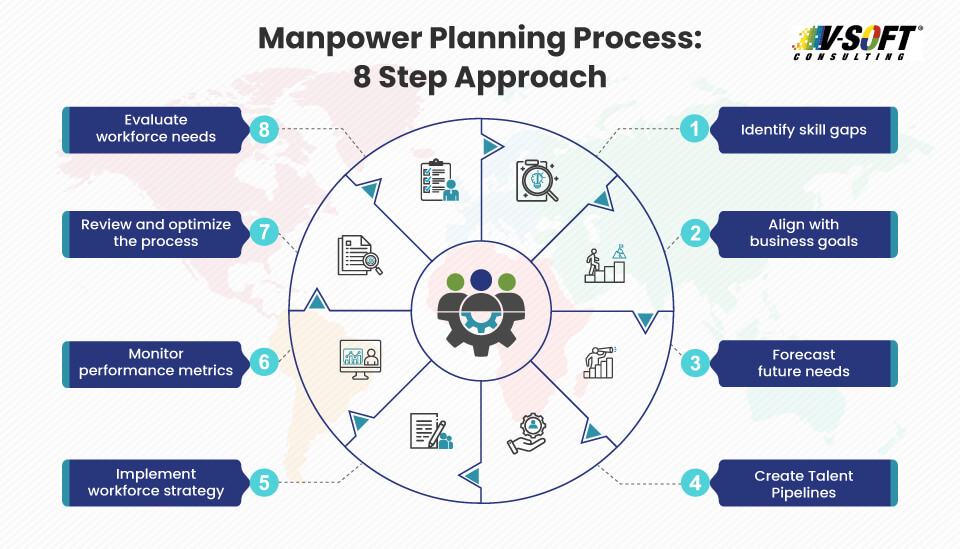
Effective manpower planning is about more than filling a seat, it’s about building a workforce that can provide lasting business success. Here are the best practices for strategic manpower planning.
1. Identify Skill Gaps
It is the first step that organizations must take when evaluating future manpower needs. Identify skills gaps by assessing the current skills of the workforce and comparing them with the skills required to meet the business objectives.
2. Align Workforce Planning with Business Goals
Start with your company's short- and long-term goals. Your manpower plan should reflect initiatives like market expansion, digital transformation, or cutting costs. That way, every recruitment or restructuring move adds up to the larger picture.
3. Forecast Future Manpower Needs
Use historical data, industry trends, and business projections to forecast future manpower needs, saving the cost of overstaffing. This supports timely hiring, targeted upskilling, and ensures the right talent is in place when needed.
4. Create Talent Pipelines
Instead of reactive recruitment, build proactive talent pipelines by investing in internship programs, employee referrals, and training provider partnerships. This gives you on-demand access to qualified talent.
5. Implement Workforce Strategy
Assess your workforce by skills and experience, performance, retirement risk, and turnover trends to identify gaps and enable proactive talent planning. Knowing exactly where you stand today allows for smarter planning decisions.
6. Monitor Performance Metrics
7. Review and Optimize the Process
Agile planning keeps your workforce ready for the unexpected. Regularly review and update your plan, monthly or quarterly, based on new business priorities, market changes, and workforce or leadership shifts.
8. Evaluate Workforce Needs
Evaluate workforce needs strategically to ensure the right talent is in the right place at the right time. By assessing skills, performance, and future gaps, leaders can proactively align their workforce with business priorities, drive productivity, and stay ahead in a rapidly changing market.
Why V-Soft for Your IT Staffing or Manpower Planning?
V-Soft Consulting is a trusted IT Staffing Consulting Partner that combines in-depth industry expertise with advanced technology to deliver tailored workforce solutions. From skilled HR professionals and cutting-edge tools to accurate forecasts of staffing needs, skills gap filling, and building agile, future-proof teams, we assist businesses in their expansion, restructuring, or dealing with talent shortages.
Whether you're expanding up, reforming employee structure, or experiencing talent deficiencies, we build your workforce strategy that helps achieve your business goals and enhance productivity at lower costs.
Final Thoughts
Manpower planning is not an HR function anymore; it's a strategic business necessity. It bridges the gap between where your business is today and where it needs be. Start planning your workforce today, and your business will see its true potential tomorrow.
FAQs
- How Often Should Manpower Planning Be Conducted?
It depends on the changing organizational needs and objectives. Organizations can schedule short-term manpower planning for one-year, medium-term planning for every 2-5 years, and long-term manpower planning with greater strategic focus could be done for every 6-8 years.
- How Do Organizations Assess Current Manpower Supply?
Evaluate the skills of current employees, identify the skill gaps, and create strategic manpower planning. This strategy assists organizations in addressing gaps in the manpower supply through recruitment, training & development, or other initiatives.
- What Are Quantitative Vs. Qualitative Approaches in Manpower Planning?
The quantitative approach helps organizations stay on top of the future workforce needs, whereas the qualitative approach deals with evaluating the experience and expertise of the current workforce and estimating the skill gaps.
- How Can Companies Align Manpower Planning with Strategic Goals?
To effectively align manpower planning with the company’s strategic goals, ensure a centralized view of all workforce initiatives for better decision-making and building targeted strategies that future-proof business operations.