



Many organizations start their Robotic Process Automation (RPA) journey with enthusiasm, only to face a harsh truth that they fail due to poor implementation. Industry studies show that 30% to 50% of initial RPA implementations fail to deliver expected value. The issue isn't with RPA technology but with how organizations deploy, scale, and govern it.
For COOs and CIOs driving automation programs, it's an alarming stat that calls for a strategic re-evaluation. RPA promises speed, efficiency, and cost reduction, but without the right strategy, it can turn into a costly experiment.
So, what really causes RPA implementations to stumble? How can organizations avoid becoming part of that 40%? How can organizations succeed by building a scalable, resilient automation framework that delivers ROI? Let's explore.
Why Do RPA Projects Fail and How to Succeed
Let's uncover the top reasons why RPA initiatives fail and ways to succeed. But before jumping into that, just recall the top RPA challenges that you are currently facing at your organization to get a better understanding.
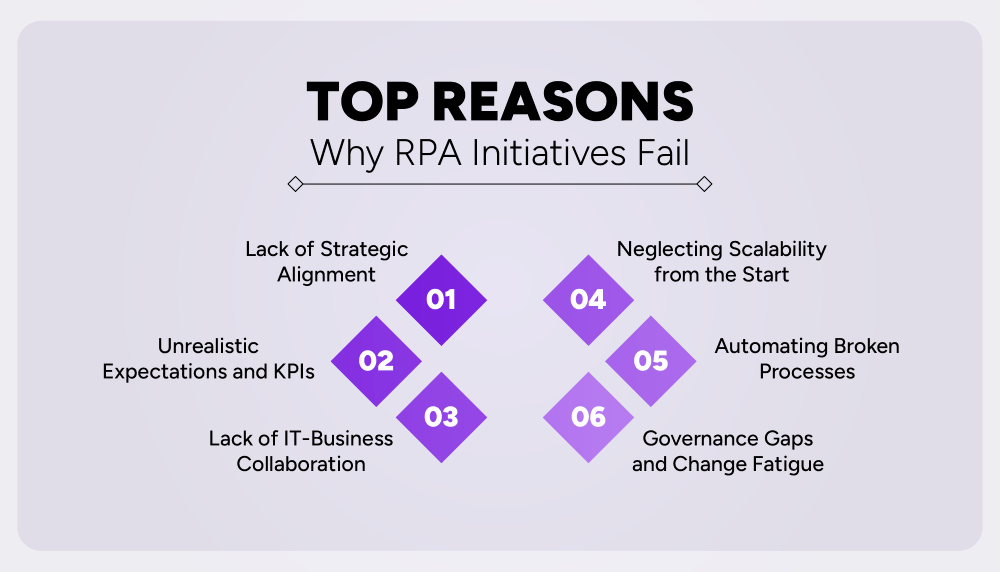
1. Lack of Strategic Alignment
Many RPA programs start in silos driven by enthusiasm from a single department rather than an enterprise-wide vision. When automation isn't tied to larger business goals, it delivers local efficiencies but not enterprise transformation.
How to succeed:
- CIOs need to ensure that automation aligns with IT architecture and scalability goals.
- COOs must verify that process selection reflects operational bottlenecks.
A strategic RPA roadmap, with IT and business co-owning outcomes, ensures the initiative scales sustainably.
According to McKinsey, aligning automation with business strategy improves ROI by up to 200% in the first year.
2. Unrealistic Expectations and KPIs
RPA isn't a silver bullet. Some organizations expect immediate transformation without considering the learning curve. RPA's success compounds over time through process maturity and incremental automation.
How to succeed:
- Set clear, realistic KPIs: cost per transaction, process accuracy, and cycle time.
- Measure adoption and utilization, not just bot count.
- Celebrate quick wins but communicate that true ROI arrives after stabilization.
3. Lack of IT-Business Collaboration
Without IT's involvement, governance suffers, and bots become fragile when system updates occur, and that is one of the key reasons why RPA projects fail.
How to succeed:
CIOs should ensure IT plays a proactive role, right from design to ongoing maintenance. Meanwhile, COOs can bridge communication between process owners and IT. Together, they ensure that automation is sustainable, not a patchwork of temporary fixes.
4. Neglecting Scalability from the Start
Many RPA pilots succeed in isolation but fail to scale across departments. This happens when organizations build bots without reusability, modularity, or shared infrastructure.
Moreover, Deloitte's survey shows that the most challenging barriers to scale are difficulties in integrating various solutions (62%), lack of skills and experience (55%), and inability to change business processes or ways of working (52%).
How to succeed:
Here are the key enablers for improved scalability:
- Reusable bot components and frameworks.
- Centralized bot monitoring dashboards.
- Integration with enterprise systems via APIs.
So, CIOs must design automation frameworks for long-term flexibility, not short-term fixes. Otherwise, every new bot becomes another maintenance burden.
5. Automating Broken Processes
Remember that automating inefficiency only scales inefficiency. Usually, teams rush to deploy bots before evaluating whether the underlying process makes sense.
A COO or process owner should ask: Is this process worth automating in its current form?
How to succeed:
Before implementation, processes should be:
- Standardized: Remove variations that confuse bots.
- Optimized: Eliminate manual approval loops or redundant steps.
- Documented: Ensure clear input/output definitions for every task.
If companies can optimize processes before automating them, then there is a massive probability of experiencing higher productivity gains.
6. Governance Gaps and Change Fatigue
Without structure, RPA programs devolve into chaos due to duplicate bots, inconsistent standards, and compliance risks. A well-defined Center of Excellence (CoE) brings accountability, documentation, and monitoring.
How to succeed:
COOs and CIOs should focus on:
- Change management: Prepare teams for automation adoption.
- Role clarity: Define ownership between IT, business, and vendors.
- Continuous improvement: Update bots as business logic evolves.
Organizations with mature governance practices can see a significant reduction in RPA maintenance costs annually.
Now that you have identified some of the top reasons why RPA initiatives fail, let us know in the comments which are the common RPA issues that match with your organization. Hope this blog has helped you find a way to address those RPA disadvantages or challenges and actions that you can take for long-term success.
Also Read: Top RPA Implementation Challenges & Solutions to Overcome
Conclusion
Is your RPA journey delivering less than you expected? We can help turn your underperforming RPA initiatives into scalable success stories. Our digital team works closely with enterprise leaders like yours to realign their automation with measurable business outcomes.
Let's identify the gaps and rebuild your RPA automation framework for measurable impact.
Schedule a Consultation with our RPA Experts
FAQs