



Today's IT leaders are facing a constant challenge: turning technology investments into measurable business impact. They must balance multiple projects, limited resources, and tight budgets. Traditional project and portfolio management tools often focus on task tracking rather than strategic alignment, leaving IT leaders with poor visibility into overall portfolio performance and value derived.
What Are the Major Limitations of Traditional Project Management Tools?
Traditional project management tools primarily focus on planning, tracking, and delivering individual projects. They can become less effective when organizations need to connect project execution with enterprise strategy, investment planning, resources, financials, and business outcomes.
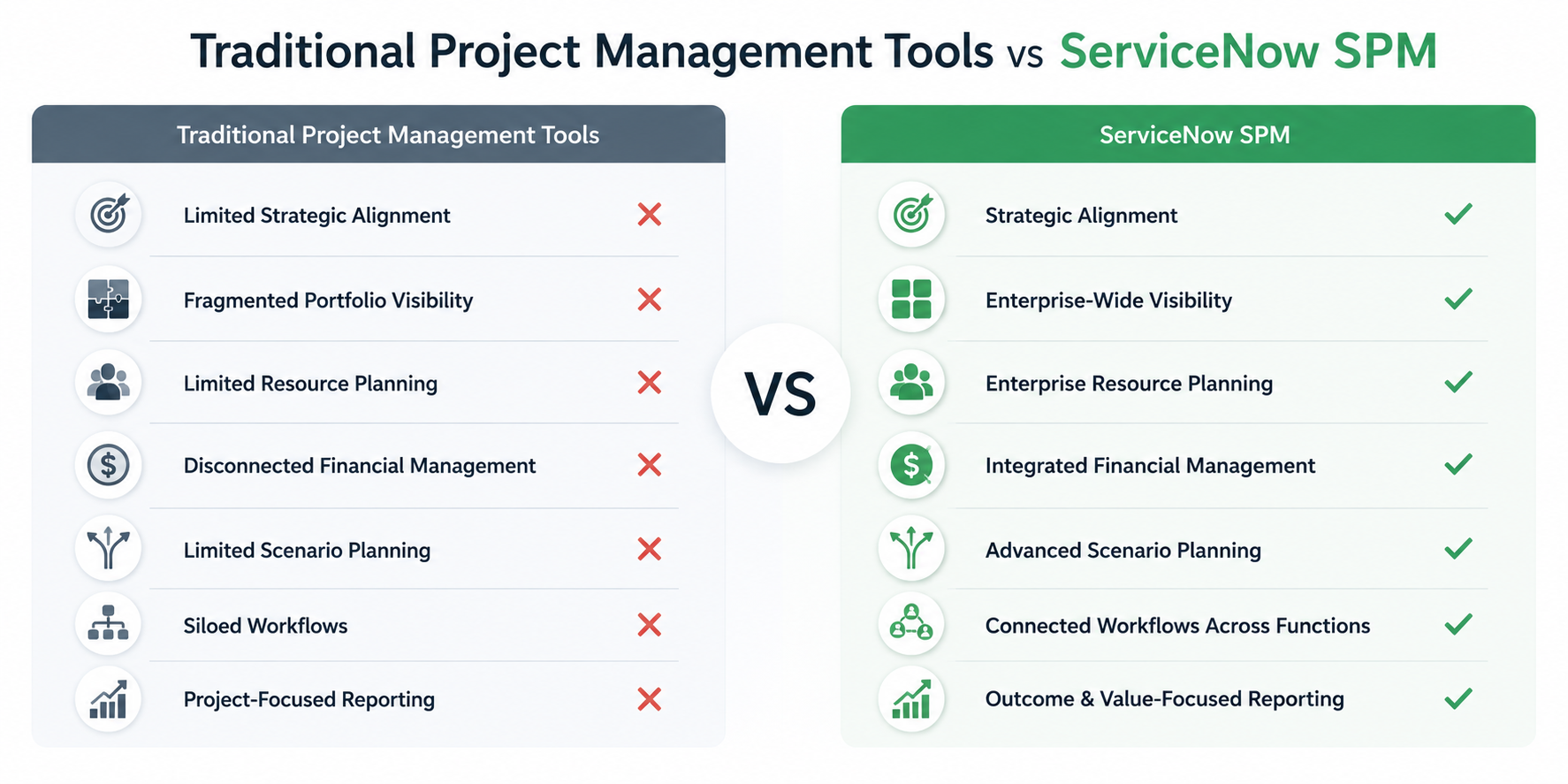
The major limitations include:
- Limited strategic alignment: Projects may be managed independently from enterprise business goals and strategic priorities.
- Fragmented portfolio visibility: Leaders may lack a centralized view of projects, investments, risks, resources, and business outcomes.
- Limited resource planning: Traditional tools often focus on project-level assignments rather than enterprise-wide capacity and demand planning.
- Disconnected financial management: Project budgets and costs may be separated from broader investment and portfolio planning.
- Limited scenario planning: Organizations may struggle to compare investment scenarios before reallocating budgets or resources.
- Siloed workflows: Project management processes may operate separately from IT, HR, finance, application management, and other enterprise functions.
- Project-focused reporting: Reporting often emphasizes schedules, milestones, and status rather than strategic value and investment performance.
For organizations seeking to drive quantifiable business value, these limitations can create inefficiencies, delays, and missed opportunities.
This is whereServiceNow Strategic Portfolio Management (SPM) makes a difference. ServiceNow SPM connects strategy, execution, and outcomes, giving IT leaders the insight and control they need. Organizations using SPM have achieved 100% visibility in enterprise applications and reduced manual workload by 78%, ensuring projects get done and move the business forward.
How does ServiceNow SPM address these limitations?
ServiceNow Strategic Portfolio Management (SPM) connects strategy, demand, portfolios, projects, resources, financial planning, and execution on a unified platform. This helps organizations evaluate investments based on strategic priorities and business value rather than managing projects in isolation.
Unlike traditional tools, ServiceNow SPM doesn't just track tasks, it prioritizes investments, optimizes resource utilization, and aligns every initiative with business objectives.
This article explores ServiceNow SPM alternatives and compares their benefits, capabilities, and cost-saving opportunities with ServiceNow SPM implementation. Let's explore.
How ServiceNow SPM Drives Strategic Value for IT Leaders?
ServiceNow SPM provides a unified approach to managing complex portfolios and projects, enabling organizations to seamlessly connect strategy, execution, and outcomes. Here are some key differentiators that set ServiceNow SPM apart from the competition:
- AI-Powered Insights for Smarter Decisions
Gain a 360° view of all initiatives, enabling IT leaders to prioritize the most impactful projects and eliminate blind spots in portfolio performance.
- Automation & Enterprise Integration
Cut manual workload and connect seamlessly with ITSM, DevOps, finance, and HR, ensuring IT initiatives run faster and stay aligned with the business.
- Resource Optimization That Maximizes Impact
Ensure top talent is allocated to high-value projects, improve capacity forecasting, and avoid bottlenecks that delay outcomes. ServiceNow SPM enhances productivity through optimal resource utilization.
- Strategic Alignment That Proves Value
IT leaders can tie every initiative directly to business objectives and measurable results, turning IT from a cost centre into a strategic driver of growth. This makes it easy for IT leaders to demonstrate the value of IT investments to executives and stakeholders.
Top Use Cases of ServiceNow SPM That Make It a Value-Driven Investment
For organizations, every dollar invested in technology must prove its worth. The ServiceNow SPM platform ensures that investments are guided by business value, not just urgency or habit. Here are key use cases where ServiceNow SPM delivers measurable impact:
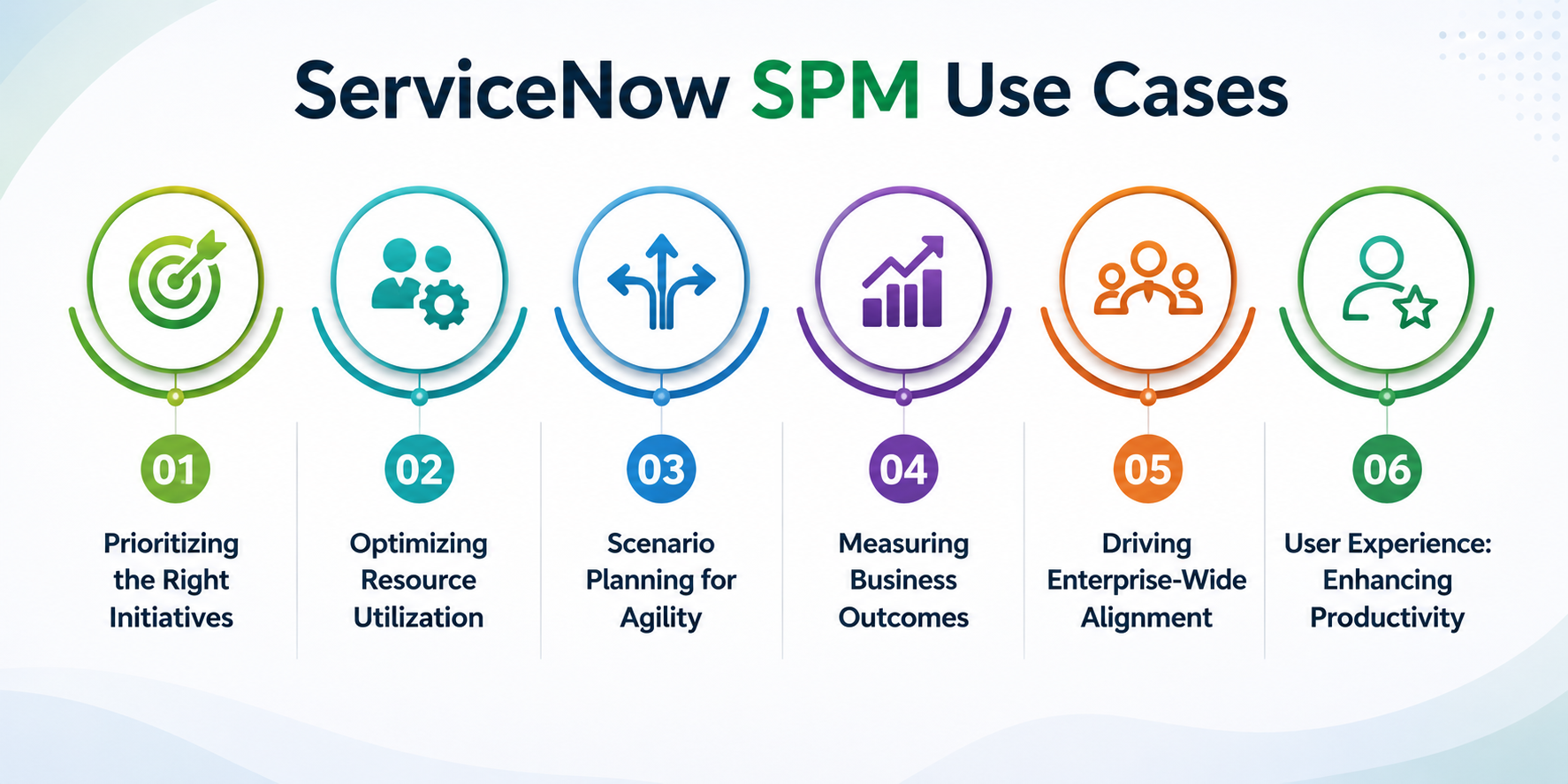
- Prioritizing the Right Initiatives
Instead of juggling endless project requests, the ServiceNow SPM module enables IT leaders to evaluate initiatives against strategic goals, financial impact, and resource capacity. The result? High-value projects rise to the top, ensuring IT investments support what matters most to the business.
- Optimizing Resource Utilization
With real-time visibility into skills, capacity, and workload, leaders can assign the right people to the right projects at the right time. This reduces burnout, eliminates bottlenecks, and accelerates delivery timelines, helping IT teams work smarter, not harder.
- Scenario Planning for Agility
When priorities shift, IT leaders no longer need to guess at trade-offs. ServiceNow SPM's scenario planning tools model multiple "what-if" situations, enabling data-driven decisions. The result? Organizations can pivot quickly without derailing ongoing initiatives.
- Measuring Business Outcomes, Not Just Outputs
Unlike traditional tools that track only tasks or milestones, ServiceNow SPM links projects to KPIs, OKRs, and ROI. Leaders gain clear visibility into how IT contributes to revenue growth, cost optimization, or customer experience improvements.
- Driving Enterprise-Wide Alignment
By integrating with ITSM, DevOps, HR, and finance, ServiceNow SPM implementation fosters enterprise-wide collaboration. Every initiative is tied to enterprise objectives, creating a shared understanding of priorities across business and technology teams.
- User Experience: Enhancing Productivity
ServiceNow SPM stands out for its intuitive user interface and design, reducing the learning curve and enhancing productivity. The user-friendly setup reduces downtime and accelerates time to value.
Further, its customization options in ServiceNow empower innovation and efficiency, distinguishing ServiceNow from other ServiceNow alternatives.
Recommended To Read:
Vision to Reality: The Power of ServiceNow SPM Implementation Services.
ServiceNow SPM vs. Alternatives: A Value-Driven Comparison
According to the Gartner report, here are the top ServiceNow Strategic Portfolio Management alternatives:
|
Feature |
ServiceNow SPM |
Jira |
Azure Boards |
Asana |
|
Primary Use Case |
Enterprise-level IT portfolio and project management. |
Agile project and issue tracking for software development teams. |
Agile project management integrated within the Microsoft ecosystem. |
Visual project management for teams, emphasizing task tracking and collaboration. |
|
Strategic Alignment |
Strong focus on aligning projects with business objectives and KPIs. |
Limited; focuses on tracking tasks and issues without direct alignment to business strategy. |
Moderate; integrates with Azure DevOps but lacks comprehensive alignment features. |
Basic; offers task and project tracking but not align workflows with objectives. |
|
Resource Management |
Advanced resource planning and optimization across portfolios. |
Basic resource tracking through plugins; lacks advanced resource management capabilities. |
Integrated with Azure DevOps for resource allocation. No resource management features. |
Basic resource management; lacks advanced features for enterprise-level resource planning. |
|
Governance & Compliance |
Robust governance frameworks, including risk management, audit trails, and compliance tracking. |
Limited governance features; primarily focused on development workflows. |
Basic governance features; integrates with Azure DevOps for some compliance tracking. |
Minimal governance features; primarily focused on task and project tracking. |
|
Integration Capabilities |
Supports integrations with ITSM, HR, finance, and other enterprise systems. |
Strong integration with the Atlassian suite and third-party tools. |
Seamless integration with the Microsoft ecosystem, including Azure DevOps and GitHub. |
Supports third-party tools but lacks deep integration with enterprise systems. |
|
User Experience |
Enterprise-grade interface with a focus on governance and strategic planning. |
Developer-centric interface with a focus on agile project tracking. |
User interface integrated within Azure DevOps. |
User-friendly interface with a focus on task and project management. |
|
Ideal For |
Mid-to-large enterprises requiring comprehensive portfolio management, strategic alignment, and governance. |
Agile development teams needing robust issue and project tracking capabilities. |
Organizations invested in the Microsoft ecosystem seeking integrated project management solutions. |
Teams seeking a visual and collaborative tool for task and project management. |
Among these ServiceNow SPM alternatives, it's clear that ServiceNow SPM stands out by offering strategic portfolio visibility, AI-driven insights, and resource optimization tools, helping organizations achieve outcomes that other tools can't match.
ServiceNow SPM vs. PPM vs. APM vs. DPM: What's the Difference?
ServiceNow SPM, PPM, APM, and DPM address different aspects of enterprise planning, investment management, and execution. While these capabilities can work together, each has a distinct primary purpose.
|
Capability |
Primary Focus |
Key Question |
Typical Use Cases |
| SPM – Strategic Portfolio Management | Strategy and investment alignment | Which investments should we prioritize? | Strategic planning, investment prioritization, demand management, resource planning, portfolio governance, financial planning. |
| PPM – Project Portfolio Management | Project and program execution | How should we plan and deliver projects? | Project planning, program management, project tracking, resource allocation, risk and dependency management. |
| APM – Application Portfolio Management | Application portfolio health | Which applications should we invest in, modernize, or retire? | Application rationalization, modernization planning, technology-risk assessment, lifecycle management. |
| DPM – Digital Portfolio Management | Digital products and investments | Which digital products and initiatives should we prioritize? | Digital product planning, digital investment prioritization, product portfolio management, digital transformation. |
Choose the Right Tool That Meets Your Organization's SPM Needs
Selecting the appropriate project and portfolio management tool depends on your organization's size, needs, existing infrastructure, and strategic objectives.
- ServiceNow SPM is ideal for mid-to-large organizations requiring comprehensive portfolio management, resource optimization, and governance alignment with their IT goals.
- Jira is suited for agile development teams that need flexible issues and project tracking but put less emphasis on enterprise-wide alignment.
- Azure Boards is best for Microsoft ecosystem, offering seamless integration with Azure DevOps and GitHub.
- Asana works well for collaborative teams that want a user-friendly, visual approach to task and project management.
Recommended To Read:
A Leading U.S. Utility Transformed Portfolio Management into a Strategic Decision-Making Engine within Weeks.
The Bottom Line
ServiceNow SPM make your IT investments work smarter. It's scalable architecture and continuous innovation ensure it adapts to evolving business needs, keeping your SPM solution relevant.
For organizations aiming to elevate project and portfolio management, V-Soft's certified ServiceNow consultants provide the guidance and support to:
- Break down portfolio silos and improve cross-team collaboration.
- Optimize resource allocation and capacity planning.
- Establish stronger governance to ensure every investment drives measurable business outcomes.
Ready to unlock the full value of your IT investments? Talk to Our ServiceNow SPM Experts Today.
FAQs
- Can ServiceNow SPM support a hybrid approach?
Yes. ServiceNow SPM supports Waterfall, Agile, and hybrid methods in one workspace. Teams can work their way, while executives get a unified view of projects, resources, and timelines.
- What post-implementation support does V-Soft provide for ServiceNow SPM?
V-Soft provides ongoing ServiceNow SPM support, including optimization, user training, integrations, licensing, and dedicated troubleshooting to ensure sustained value and seamless adoption.
-
What does ServiceNow SPM architecture include?
ServiceNow SPM connects strategy, portfolios, demand, projects, resources, financials, and performance on a unified platform. Specific capabilities depend on the organization’s ServiceNow subscription and configuration.
What is the difference between ServiceNow SPM Standard and Pro?
SPM Standard and Pro are different ServiceNow subscription packages with different capabilities and entitlements. The right option depends on your portfolio-management requirements, users, integrations, and desired functionality.
How difficult is it to migrate from another SPM or PPM platform to ServiceNow SPM?
Migration complexity depends on data volume, customizations, integrations, workflows, and reporting requirements. A structured assessment, data mapping, process redesign, and phased migration can simplify the transition.
Can SPM use application data from APM for portfolio decisions?
Yes. APM data can inform SPM investment decisions by providing visibility into application cost, risk, business value, lifecycle, and technology health.
Can ServiceNow SPM integrate with existing project management and financial systems?
Yes. ServiceNow SPM can integrate with project management, financial, HR, ERP, and other enterprise systems, helping organizations connect portfolio, project, resource, and financial data.