



Many enterprises achieve ServiceNow implementation success but struggle to sustain business value as workflows expand, customizations accumulate, and platform complexity increases. The challenge is no longer deploying the platform; it is continuously optimizing ServiceNow to evolve with business needs and deliver measurable value.
This article explores how four critical capabilities, adoption, workflow modernization, governance, and AI readiness, help organizations maximize ServiceNow ROI and transform the platform into an intelligent enterprise platform.
Key Takeaways
Organizations maximize ServiceNow ROI by:
- Moving beyond implementation milestones to continuous platform optimization
- Eliminating workflow complexity before applying automation
- Reducing technical debt through governance and standardization
- Improving adoption by making ServiceNow the easiest way to get work done
- Preparing enterprise data, workflows, and governance for AI-driven operations
- Measuring business outcomes instead of platform activity
What Is ServiceNow ROI and Why ServiceNow ROI Declines Over Time?
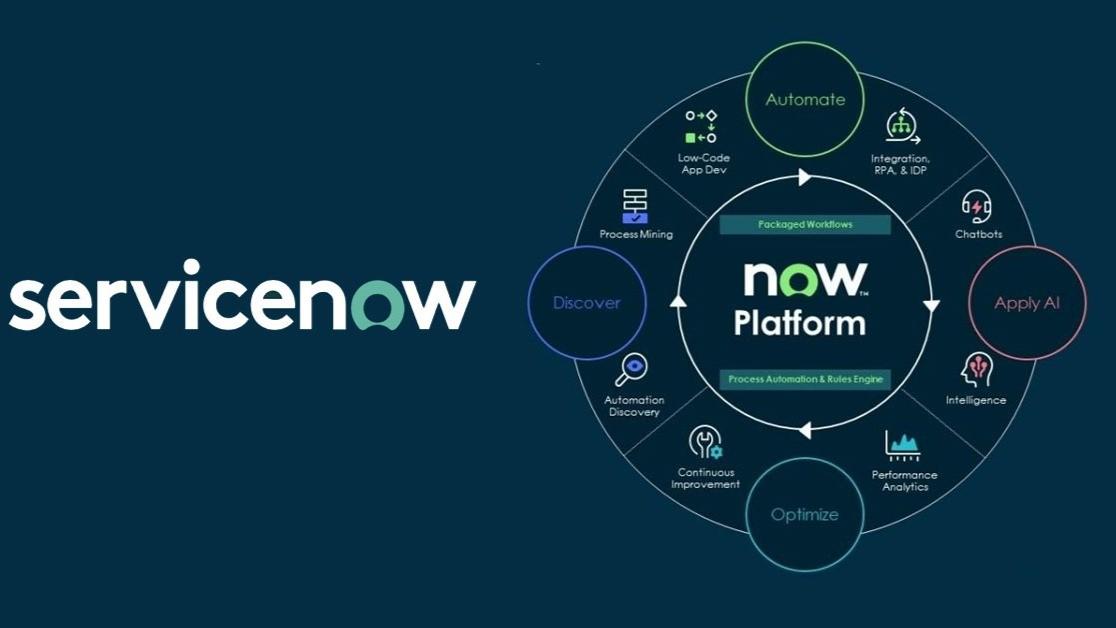
ServiceNow ROI measures the business value generated from the platform. Traditional ROI metrics focus on implementation success, module adoption, ticket volumes, platform utilization, or workflows deployed. While these metrics demonstrate whether the platform has been implemented successfully, they do not measure whether it continues to create long-term business value.
Business leaders evaluate ROI differently. They ask whether ServiceNow continues to:
- Reduce operational friction.
- Accelerate work across the enterprise.
- Improve business decision-making.
- Enable future automation and AI initiatives.
When viewed through this lens, ServiceNow ROI becomes an ongoing value realization journey rather than a one-time implementation milestone.
The challenge is that ROI naturally declines when the platform evolves faster than it is optimized.
As organizations expand ServiceNow across departments, workflows become more complex, customizations accumulate, governance becomes inconsistent, and technical debt grows. Employees begin creating workarounds, manual processes reappear, upgrades become more difficult, and automation initiatives become increasingly expensive to scale.
These challenges rarely result from a single implementation decision. Instead, they emerge gradually through hundreds of small changes made over months or years.
Organizations often respond by deploying additional modules or introducing new technologies. However, expanding the platform rarely solves operational complexity. Long-term ROI comes from continuously strengthening the foundation on which the platform operates.
This raises an important question: How can organizations continuously increase ServiceNow ROI instead of watching it gradually decline?
How Organizations Sustain and Increase ServiceNow ROI
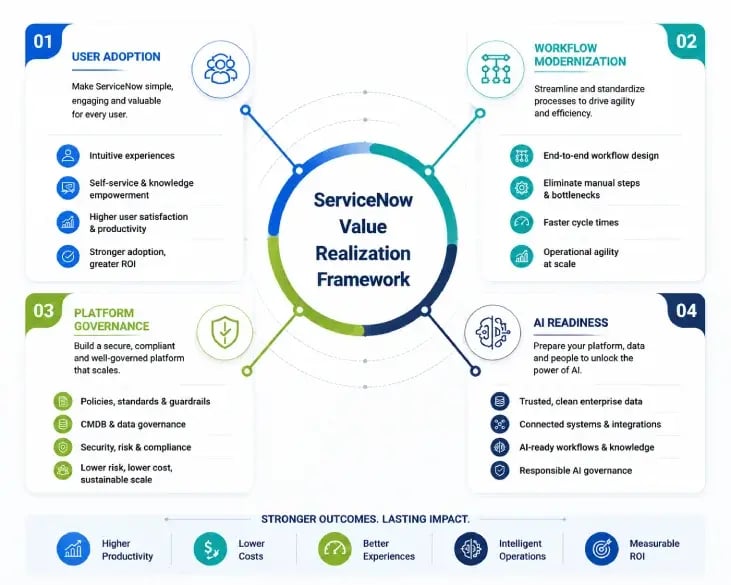
Organizations that consistently maximize ServiceNow ROI don't treat optimization as a one-time initiative. Instead, they continuously strengthen four interconnected capabilities that keep the platform aligned with evolving business needs.
Rather than focusing solely on deploying new functionality, they simplify how work gets done, increase platform adoption, establish governance, and strengthen the operational foundation required for intelligent automation.
This continuous optimization approach enables ServiceNow implementation to evolve alongside the business instead of becoming increasingly complex over time.
At V-Soft, we organize these capabilities into a practical framework that helps organizations evaluate platform maturity, identify optimization opportunities, and continuously increase business value.
The ServiceNow Value Realization Framework
Organizations maximize long-term ServiceNow ROI when these four capabilities mature together rather than independently.
1. User Adoption
2. Workflow Modernization
3. Platform Governance
4. AI Readiness
Together, these capabilities determine whether ServiceNow remains a system of record or evolves into an intelligent business platform.
1. User Adoption: The Foundation of Platform Value
A ServiceNow platform can be technically successful and still deliver limited business impact if employees avoid it or continue relying on manual processes. Low adoption is rarely a training problem. It is usually a workflow design problem. It is an indicator of whether the platform is designed around how employees actually work.
Organizations improve adoption by creating intuitive experiences, simplifying service journeys, removing unnecessary approvals, and designing workflows around how employees actually work.
Strong adoption creates better operational visibility, improves data quality, and increases opportunities for automation. A platform employees do not actively use cannot generate the trusted data and insights required for intelligent operations.
As organizations improve adoption, they gain greater visibility into how work actually flows across the enterprise. That visibility often reveals another challenge: many workflows have been digitized but not optimized.
Recommended Read: Accelerating ServiceNow Adoption: Change Management That Works
2. Workflow Modernization: Simplify Before You Automate
One of the most common mistakes organizations make is automating processes before optimizing them. Automation can accelerate execution, but it cannot eliminate unnecessary approvals, unclear ownership, redundant steps, or inefficient handoffs.
Organizations achieve greater ServiceNow ROI when they first simplify workflows, standardize processes, and then apply automation where it creates measurable business value. Before automating any workflow, leaders should evaluate:
- Where does work stop?
- Where do manual handoffs occur?
- Which approvals create delays?
- Where is information duplicated?
- Which decisions require human judgment?
The goal is not: “Where can we automate?” The goal is: “Where can we simplify so automation creates measurable impact?”
This approach improves cycle times, reduces operational friction, and creates workflows that are easier to scale across the enterprise.
eGuide: Transform hidden inefficiencies into cost-saving opportunities with our expert-backed guide.
3. Platform Governance - Protect Long-Term ServiceNow Value
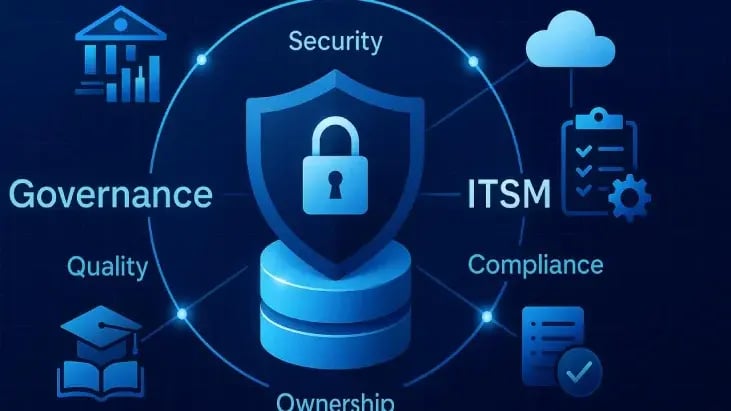
Enterprise ServiceNow complexity rarely comes from one major decision. It develops through years of incremental changes.
- A customization created for one business requirement.
- A workflow exception added for one department.
- A configuration change made without considering long-term impact.
Over time, these decisions can increase technical debt and make the platform harder to maintain. Effective governance provides the structure needed to balance innovation with platform health. This includes customization standards, data ownership, workflow alignment, and clear accountability for platform decisions.
Governance does not slow innovation. It reduces technical debt, simplifies upgrades, and creates the consistency required to scale automation and AI with confidence.
Beyond reducing technical debt, governance establishes the trusted data, standardized processes, and decision boundaries that enterprise AI depends on.
4. AI Readiness: Build an AI-Ready ServiceNow Foundation
Is Your ServiceNow Platform Ready for Enterprise AI? AI is changing how organizations think about ServiceNow. Capabilities such as Now Assist and AI Agents create opportunities to improve productivity, automate decisions, and transform operational processes. However, AI success depends on the maturity of the foundation underneath it. Organizations must evaluate:
- Data Readiness
Can the organization trust the data AI will use for recommendations and decisions?
- Workflow Readiness
Are processes standardized enough to support intelligent automation?
- Integration Readiness
Can connected systems provide the business context required for AI-driven outcomes?
- Governance Readiness
Are policies, ownership models, and decision boundaries defined for AI-assisted operations?
Together, these capabilities represent progressively higher levels of platform maturity, providing a more meaningful way to measure long-term ServiceNow ROI.

The V-Soft ServiceNow ROI Maturity Model: A Framework for Continuous Value Realization
V-Soft helps organizations translate assessment findings into measurable business outcomes through a structured optimization approach that improves platform health, simplifies operations, reduces technical debt, and prepares ServiceNow for enterprise AI.
Rather than measuring success by the number of modules deployed or workflows automated, evaluate how effectively the ServiceNow platform enables standardized operations, governance, automation, and AI-ready execution across the enterprise.
| Maturity Level | Characteristics | Business Impact |
|---|---|---|
| Level 1: Deployed Foundation | Core ServiceNow capabilities are live, but adoption and processes remain inconsistent across business units. | Operational gains are realized, but ROI is constrained by fragmented workflows and inconsistent usage. |
| Level 2: Standardized Operations | Workflows are standardized, adoption improves, and manual work is reduced. | Better visibility, higher data quality, and improved operational efficiency. |
| Level 3: Enterprise Optimization | Governance, automation, and platform health are continuously optimized. | Lower technical debt, easier upgrades, and greater business agility. |
| Level 4: Intelligent Enterprise | Trusted data, standardized workflows, and governance enable enterprise AI. | AI scales confidently, improving productivity, decision-making, and long-term ROI. |
This maturity model helps organizations:
- Benchmark their current ServiceNow maturity.
- Identify the operational gaps limiting ROI.
- Strengthen the foundational capabilities that drive long-term ServiceNow value.
- Build a phased roadmap from platform deployment to intelligent enterprise operations.
Each maturity level builds on the previous one, enabling organizations to increase ServiceNow ROI incrementally while preparing the platform for intelligent automation and enterprise AI. Rather than treating optimization as a one-time initiative, the model provides a repeatable framework for continuously increasing ServiceNow ROI as business needs evolve.
Is Your ServiceNow Platform Ready for Higher ROI?
Before investing in additional automation or AI capabilities, leaders should evaluate whether their current ServiceNow foundation can support the next stage of growth.
A practical ServiceNow ROI assessment checklist:
Adoption
- Do employees complete work primarily through ServiceNow?
- Are users avoiding the platform because processes are complicated?
Workflow Optimization
- Are workflows standardized across business units?
- Have unnecessary approvals and handoffs been removed?
Governance
- Is technical debt actively measured and reduced?
- Are customization decisions aligned with enterprise strategy?
AI Readiness
- Is enterprise data trusted?
- Can AI access the enterprise context required to support business decisions?
- Are governance boundaries defined?
If more than three answers are "no," foundational improvements should take priority before expanding automation or AI initiatives.
How V-Soft Helps Enterprises Maximize ServiceNow ROI
V-Soft helps organizations improve ServiceNow ROI by combining platform optimization, workflow modernization, governance, and AI readiness into a structured transformation approach. Our approach focuses on:
- Assess: Identify maturity gaps across workflows, governance, data, and AI readiness.
- Optimize: Remove operational friction, simplify processes, and improve adoption.
- Modernize: Reduce technical debt and prepare the platform for automation.
- Govern: Establish operating models that reduce complexity while enabling continuous innovation.
- Scale: Enable AI-driven operations on a trusted ServiceNow foundation.
Our goal is to help organizations move from managing ServiceNow as an application to optimizing it as an enterprise business platform, one that continuously creates measurable business value.
Conclusion
Maximizing ServiceNow ROI isn't about deploying more features; it's about continuously optimizing the platform to meet evolving business needs. At V-Soft, we help enterprises increase long-term ServiceNow value by improving platform adoption, modernizing workflows, strengthening governance, and building AI-ready foundations that enable measurable business outcomes and sustainable innovation.
Schedule a ServiceNow ROI Maturity Assessment