



Most GenAI pilots do not fail because of the technology. They fail because enterprises underestimate what it actually takes to operationalize AI at scale.
Just one year ago, launching a GenAI pilot felt innovative for most enterprises. Today, almost every enterprise is experimenting with AI in some form, right from internal copilots and AI-powered search to customer support assistants and workflow automation.
The problem is that experimentation is growing much faster than measurable business value.
According to McKinsey & Co., Generative AI has the potential to add up to $4.4 trillion in additional value to the AI market. This potential has led more than $78% of companies to use GenAI in at least one business function.
Yet only a small percentage say they have successfully scaled GenAI in a way that materially impacts the bottom line.
That gap matters. Because many enterprises are now discovering something uncomfortable: GenAI pilots are surprisingly easy to launch, but much harder to operationalize.
- - A chatbot demo may impress leadership.
- - A proof of concept may work perfectly in a controlled environment.
But enterprise ROI is not measured by demos. It is measured by adoption, workflow integration, operational efficiency, risk reduction, and long-term business impact.
Gartner predicts that at least 30% of generative AI projects will be abandoned after proof-of-concept stages due to poor data quality, inadequate risk controls, unclear business value, or escalating costs.
The failures are rarely caused by the model itself. More often, the real problems sit underneath:
- Fragmented enterprise data
- Disconnected workflows
- Governance gaps
- Infrastructure limitations
- Rising operational costs
- Unrealistic ROI expectations
The organizations generating measurable AI outcomes today are not necessarily the ones deploying GenAI the fastest. They are the ones operationalizing AI most effectively.
Why Enterprise GenAI ROI Is Harder Than Most Organizations Expect
Most GenAI pilots succeed technically.
The model generates responses. The assistant works. The workflow appears functional during demonstrations.
But operationally, the story is often very different.
- - Employees stop using the tool after a few weeks.
- - Responses become unreliable because enterprise data is inconsistent.
- - Security teams raise governance concerns.
- - Cloud costs rise unexpectedly.
- - Different departments deploy disconnected AI tools with no centralized strategy.
Eventually, leadership starts asking the question many organizations are now facing: “Where exactly is the ROI?”
That frustration is becoming increasingly common across enterprise AI initiatives. In fact, IBM’s Institute for Business Value found that enterprise-wide AI programs achieved an average ROI of just 5.9% despite requiring nearly 10% capital investment, highlighting the growing gap between AI experimentation and measurable business impact.
That is because enterprise AI maturity has very little to do with deploying a model itself. It depends on whether the organization can operationalize AI across:
- Workflows
- Governance processes
- Data environments
- Infrastructure
- Security
- Employee adoption
- Business decision-making
In simple terms, AI success is increasingly becoming an operational maturity challenge and not just a technology challenge.
And that distinction changes everything.
Because once enterprises move beyond experimentation, they quickly realize that GenAI introduces entirely new layers of complexity:
- Infrastructure scaling
- Retrieval accuracy
- Data governance
- Latency optimization
- Compliance management
- Cost visibility
- Model orchestration
- Workflow integration
Many organizations underestimate this part completely.
The result?
AI pilots that look impressive initially but fail to produce measurable business value six months later.
So, what exactly is preventing many enterprise GenAI pilots from delivering measurable ROI?
5 Biggest Reasons Enterprise Gen AI Pilots Fail to Show ROI
Most enterprise GenAI failures are not caused by weak models; they are caused by operational gaps organizations underestimate early in the journey. Let’s delve into the reasons.
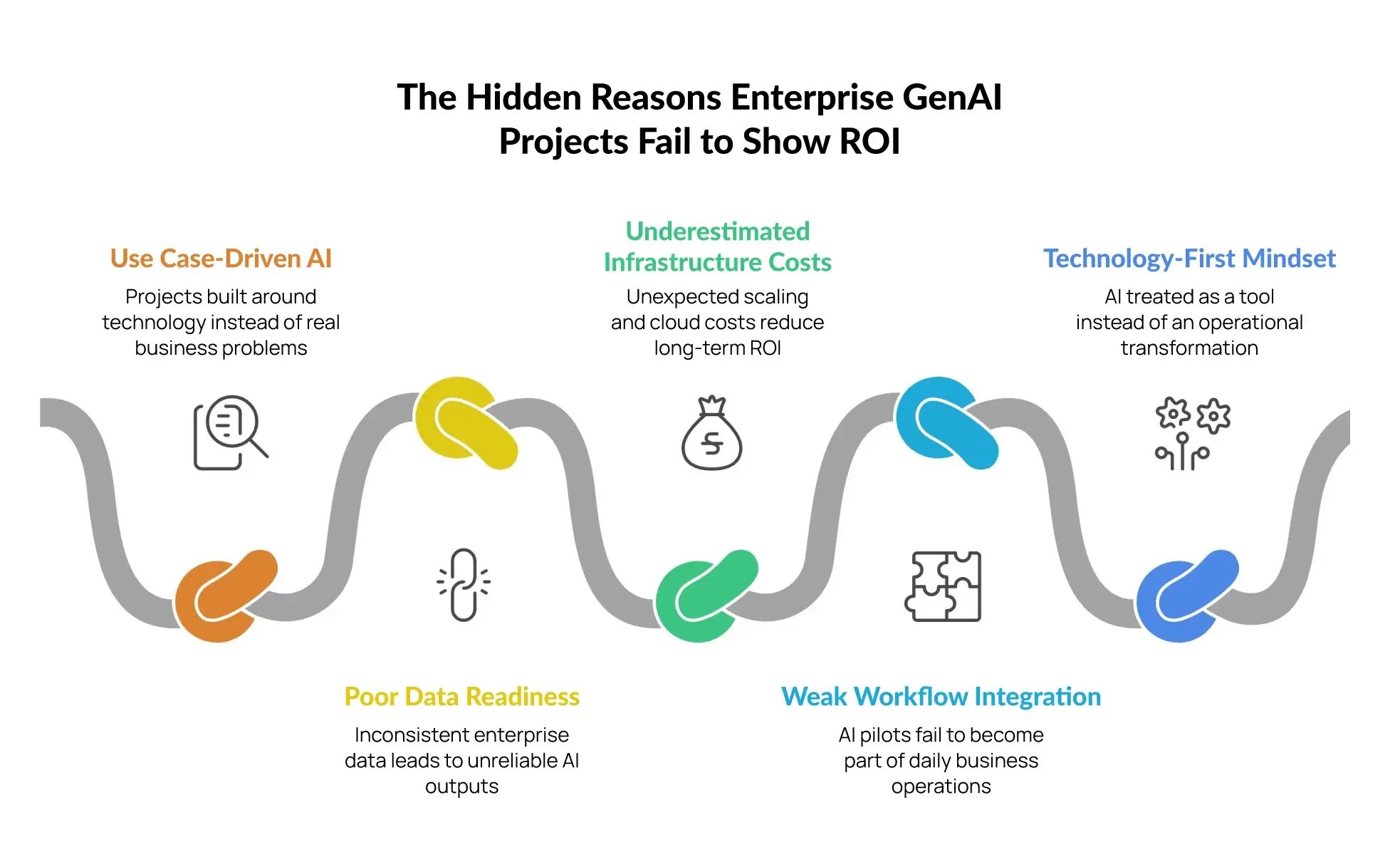
Reason 1: Enterprises Start with Use Cases Instead of Business Problems
This is probably the most common GenAI mistake right now.
Many organizations begin with the question: “What can we build with AI?”
Instead of asking: “What business problem are we actually solving?”
That difference changes everything. Because when AI projects begin with technology excitement rather than business outcomes, pilots often become disconnected from measurable value.
Teams build copilots, assistants, and summarization tools without clearly defining:
- Operational KPIs
- Adoption targets
- Workflow efficiency improvements
- Cost reduction expectations
- Revenue impact metrics
The result is what many enterprises quietly experience today: AI tools that technically work but do not materially improve business performance.
Successful enterprise AI strategy starts with real operational pain points such as:
- Slow knowledge retrieval
- Overloaded support teams
- Inefficient workflows
- Repetitive manual work
- Delayed decision-making
Without that alignment, proving ROI becomes extremely difficult.
McKinsey notes that organizations seeing stronger ROI from GenAI are significantly more likely to tie AI initiatives directly to business objectives instead of treating AI as a standalone innovation project.
Reason 2: Poor Enterprise Data Readiness Breaks AI Outcomes
Most GenAI conversations focus heavily on models. But in enterprise environments, the real challenge is usually data.
Enterprise information is often scattered across:
- Legacy systems
- PDFs
- SharePoint environments
- Disconnected SaaS platforms
- Internal portals
- Duplicated databases
Even the most advanced AI models can only perform as well as the data behind them. If the underlying enterprise data is inconsistent, outdated, duplicated, or inaccessible, outputs quickly become unreliable.
Gartner estimates that 85% of AI projects and models fail because of poor data quality, weak data governance, or insufficient relevant data.
This is one of the biggest reasons enterprise users lose trust in GenAI systems. Because once responses become inaccurate a few times, adoption drops sharply.
According to IBM research, “data complexity and governance concerns remain among the top barriers preventing enterprises from scaling AI initiatives successfully.”
Here’s the deeper issue many organizations underestimate:
GenAI systems depend heavily on retrieval quality, metadata consistency, permission structures, and governance controls.
Strong AI outcomes require:
- Clean enterprise data
- Unified knowledge environments
- Governance controls
- Structured retrieval systems
- Consistent metadata frameworks
In enterprise AI transformation, data maturity often matters more than model sophistication.
Reason 3: Infrastructure and AI Scaling Costs are Widely Underestimated
Many organizations still approach GenAI as a software initiative. In reality, enterprise AI quickly becomes an infrastructure challenge.
Inference workloads, GPU utilization, latency optimization, vector databases, orchestration pipelines, and scaling costs introduce an entirely different level of operational complexity.
What begins as a small pilot often evolves into:
- Unpredictable cloud costs
- Performance bottlenecks
- Scaling limitations
- Security concerns
- Governance overhead
- Compliance pressure
This becomes even harder when enterprises attempt to support AI workloads across multiple departments simultaneously, especially without centralized governance and scalable infrastructure planning.
Many pilots fail to show ROI not because AI lacks value, but because organizations underestimate the operational cost of scaling AI responsibly.
Reason 4: AI Pilots Fail to Integrate into Real Business Workflows
This is where many enterprise GenAI projects quietly lose momentum.
A pilot may function perfectly in a demo environment. Employees may even find it interesting initially. But if the AI system is not deeply integrated into daily workflows, adoption declines quickly.
Employees return to existing habits. Teams stop relying on the tool. Business processes remain unchanged.
And eventually, the pilot becomes another isolated innovation project with limited measurable impact.
Successful AI systems integrate directly into:
- Enterprise applications
- Employee decision-making workflows
- Operational processes
- Collaboration environments
- Knowledge systems
AI creates measurable value when it becomes embedded inside how work actually happens and not when it exists as a standalone innovation initiative. This is one of the biggest differences between successful enterprise AI strategy and disconnected experimentation.
Reason 5: Enterprises Treat AI as a Technology Initiative Instead of an Operational Transformation
This is the biggest reason many GenAI pilots fail to scale successfully.
Enterprises often treat AI as a standalone technology initiative owned by a single department. But GenAI impacts far more than technology alone.
It affects:
- Governance
- Compliance
- Operations
- Employee workflows
- Infrastructure
- Risk management
- Security
- Business processes
And this lack of operational alignment quietly slows many AI initiatives down.
McKinsey research notes that organizations often spend nearly 30% to 50% of their GenAI innovation efforts either addressing compliance concerns or waiting for internal governance policies to catch up with AI adoption.
That is why the organizations generating meaningful AI ROI today are investing heavily in:
- AI governance frameworks
- Centralized strategy
- Operational coordination
- Cross-functional ownership
- Long-term AI operating models
The real shift happening right now is this: AI maturity is increasingly becoming operational maturity.
And honestly, this is where many enterprises are still unprepared.
What High-Performing Enterprises Are Doing Differently
The enterprises generating measurable ROI from GenAI are approaching AI very differently.
Instead of chasing rapid experimentation alone, they focus on operational readiness from the beginning.
That includes:
- Aligning AI initiatives with business outcomes
- Improving enterprise data quality
- Building governance frameworks early
- Planning infrastructure scalability
- Integrating AI into real workflows
- Measuring adoption continuously
- Aligning AI investments with operational KPIs
Most importantly, they treat AI as a long-term transformation initiative rather than a short-term innovation project.
That mindset changes how AI investments are planned, deployed, governed, and scaled.
How CIOs and CTOs Should Evaluate Enterprise AI Readiness
Before scaling GenAI initiatives, executive leaders should evaluate 5 critical areas:
| AI Readiness Area | Key Executive Question |
|---|---|
| Business Alignment | Is AI tied directly to measurable operational outcomes? |
| Data Readiness | Can enterprise data support reliable AI retrieval and governance? |
| Infrastructure | Can systems scale securely and cost-effectively? |
| Workflow Integration | Will employees use AI inside existing workflows? |
| Governance | Are compliance, security, and risk controls established? |
Organizations that address these foundational areas early are significantly more likely to achieve sustainable AI ROI.
Conclusion
The biggest GenAI challenge facing enterprises today is not model capability. It is operationalization.
The organizations struggling with ROI are often approaching AI as a technology experiment. The organizations generating measurable value are approaching it as an operational transformation strategy.
The companies generating measurable ROI are not simply deploying more AI tools. They are building operationally mature AI environments that combine governance, infrastructure, workflow integration, data readiness, executive alignment, and long-term enterprise AI strategy.
As enterprise AI adoption accelerates, competitive advantage will increasingly belong to organizations that operationalize AI effectively and not just experiment with it.
Because eventually, every enterprise will have access to powerful AI tools. The real advantage will come from knowing how to operationalize them effectively.
Is your GenAI strategy truly built for measurable enterprise ROI?
Talk to V-Soft Consulting about building scalable, secure, and operationally mature AI environments designed for long-term business impact.
Frequently Asked Questions