
.jpg)


AI-native low-code development is transforming how enterprises build software. Applications that once required months of development effort can now be designed, tested, and deployed in days. Business teams can automate workflows, launch new capabilities, and respond to changing requirements faster than ever before.
Yet many organizations are discovering an unexpected reality: faster software delivery does not automatically translate into faster business outcomes.
Projects move rapidly through development but stall during prioritization. Automation initiatives launch successfully but struggle to scale across the enterprise. New applications are deployed at unprecedented speed, yet operational performance often improves more slowly than expected.
The assumption that faster software creation automatically leads to faster transformation is proving incomplete.
AI-native low-code development removes friction from software creation. It does not automatically remove friction from decision-making, governance, coordination, integration, or value realization. As development accelerates, these organizational constraints become increasingly visible.
The Hidden Gap in AI-Native Low-Code Success
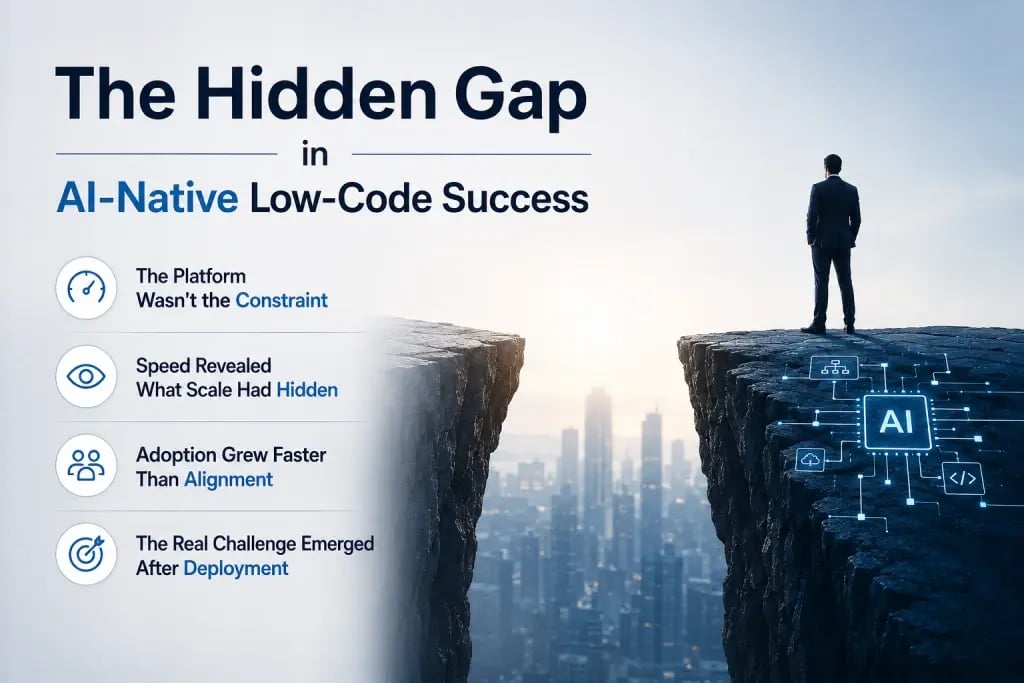
AI-native low-code platforms are dramatically accelerating application development. Organizations can build, automate, and deploy solutions faster than ever before.
Organizations are encountering an unexpected challenge. Despite faster development cycles, business outcomes are not improving at the same rate.
The issue is not development speed. The blocker is a growing gap between software creation and business execution.
This is the AI-Native Execution Gap.
What Is Execution Drag in AI-Native Development?
The AI-Native Execution Gap is the growing distance between an organization's ability to build applications and its ability to operationalize business value from those applications.
Historically, development capacity limited innovation. Organizations could only build a finite number of applications, forcing teams to prioritize carefully and align resources around the most important initiatives.
AI-native development changes that equation.
Applications, workflows, automations, and digital experiences can now be created faster and by more people than ever before. AI-assisted development, citizen development, and low-code platforms are dramatically expanding enterprise delivery capacity.
However, while software creation has accelerated, many operating models have not evolved at the same pace.
Decision-making remains slow. Governance processes remain fragmented. Integration complexity continues to grow. Organizational alignment often struggles to keep pace with technical innovation.
As a result, the ability to build is increasing faster than the ability to execute. That gap is becoming one of the most important challenges in enterprise transformation.
Evidence That the AI-Native Execution Gap Is Growing
The emergence of the AI-Native Execution Gap is supported by broader industry trends.
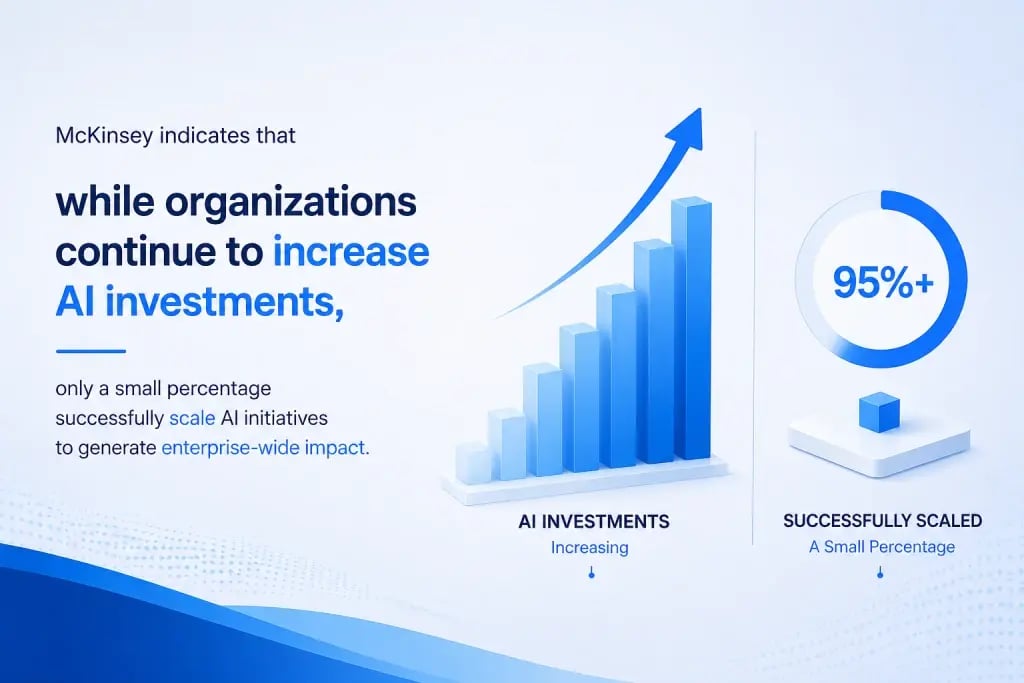
Also, Deloitte reports that “most organizations are investing in AI capabilities, yet significantly fewer have achieved broad operational integration across the business.”
Industry analysts have also observed that technology capacity is no longer the primary constraint to transformation. Increasingly, organizations are constrained by decision latency, organizational alignment, governance complexity, and execution readiness.
The pattern is becoming clear: enterprises are improving their ability to build faster than their ability to operationalize value.
Why Faster Development Doesn't Automatically Create Faster Transformation
A common assumption in enterprise technology strategy is that development speed and transformation speed are directly connected.
At first glance, the logic appears sound. If applications can be delivered faster, organizations should improve operations faster. If automation can be implemented more quickly, efficiency should improve more rapidly. If development cycles shrink, business outcomes should arrive sooner.
In practice, transformation depends on far more than software delivery.
Transformation occurs when technology changes how work gets done, how decisions are made, how customers are served, and how value is created across the business.
Software delivery is only one component of that equation. Prioritization, governance, adoption, integration, workflow alignment, data consistency, and organizational change all influence whether technology investments generate measurable outcomes.
This explains why some organizations dramatically improve delivery velocity while achieving only modest improvements in operational performance.
AI-native development increases execution capacity. It does not automatically improve the systems responsible for directing, governing, and scaling that capacity.
How AI-Native Development Changes the Economics of Software Creation
The most significant impact of AI-native development is not speed. It is abundance.
Historically, software development operated under scarcity. Development resources were limited, technical expertise was expensive, and application delivery required substantial effort. Scarcity naturally imposed prioritization.
AI-native development removes many of those constraints.
Applications are easier to build. Automations are easier to create. Workflows can be generated and modified rapidly. Business users can increasingly participate directly in solution development.
The result is a shift from software scarcity to software abundance. Organizations are no longer constrained primarily by their ability to build applications. They are increasingly constrained by their ability to govern, integrate, prioritize, and scale the growing volume of applications being created.
As software abundance grows, execution bottlenecks become more visible. This is where the AI-Native Execution Gap begins to emerge.
What Causes the AI-Native Execution Gap?
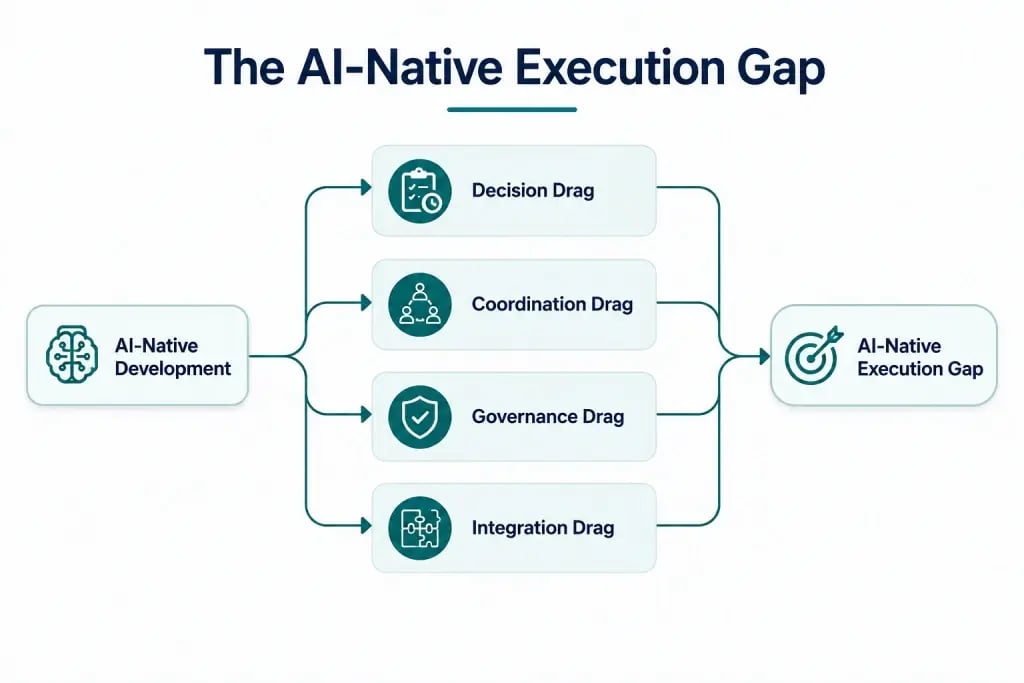
The AI-Native Execution Gap is rarely caused by technology limitations. More often, it is created by operational constraints that become visible as software creation accelerates.
1. Decision Drag
AI-native platforms accelerate software delivery, but they also increase the need for faster business decisions.
Ownership, prioritization, funding, risk tolerance, and success metrics must be established with greater speed and clarity.
Many organizations discover that development velocity now exceeds decision velocity. Applications can be built faster than leaders can align around what should be built next.
2. Coordination Drag
AI-native development enables more teams to innovate independently. While this increases agility, it also increases the need for enterprise-wide coordination.
Without shared standards and visibility, organizations often create overlapping applications, duplicate workflows, and fragmented experiences.
The challenge is no longer creating solutions. The challenge is ensuring those solutions operate as part of a connected business system.
3. Governance Drag
As application portfolios expand, governance complexity increases.
Organizations must maintain security, compliance, lifecycle management, operational standards, and data consistency across a rapidly growing ecosystem of applications and automations.
Without scalable governance, innovation begins to outpace visibility and control.
4. Integration Drag
Every application introduces dependencies across systems, workflows, and data sources.
As application volume grows, integration often becomes the primary constraint on value realization.
Disconnected workflows, fragmented data, and inconsistent business processes create friction that slows execution regardless of how quickly applications are delivered.
Why Execution Efficiency Is Becoming the New Competitive Advantage
For years, organizations competed through development efficiency. Today, development efficiency is increasingly becoming a baseline capability. As AI makes software creation faster, more accessible, and more scalable, competitive advantage is shifting from development efficiency to execution efficiency.
Execution efficiency is the ability to convert technology investments into business outcomes with minimal friction.
It requires alignment between business and technology teams, governance that enables innovation without sacrificing control, integrated operations, and clear accountability for outcomes.
Most importantly, it requires a deliberate connection between what gets built and why it matters.
Organizations that close the AI-Native Execution Gap will create significantly more value from AI-native development than organizations that simply build more applications.
What an AI-Native Operating Model Requires
Traditional operating models were designed for software scarcity. AI-native operating models must be designed for software abundance.
Leading organizations are increasingly focusing on four foundational capabilities:
- Governance Management
Establishes security, compliance, visibility, lifecycle controls, and accountability across the application portfolio.
- Workflow Orchestration
Ensures processes remain aligned across functions and prevents workflow fragmentation as applications scale.
- Integration Architecture
To connect applications, systems, and data to create a unified operational environment.
- Value Realization Layer
Measures how applications contribute to business performance, operational efficiency, customer outcomes, and strategic objectives.
Together, these capabilities transform development velocity into business value.
V-Soft Helps Enterprises Scale AI-Native Low-Code Development
V-Soft helps organizations move beyond application delivery and focus on execution outcomes.
Our approach combines AI-native development expertise with governance design, workflow architecture, integration strategy, and value realization frameworks.
This enables enterprises to accelerate innovation while maintaining visibility, alignment, and control.
Rather than allowing software abundance to create complexity, organizations can establish a scalable operating model that turns AI-native development into sustainable business advantage.
Conclusion
The next phase of AI-native transformation will not be defined by how quickly enterprises can build software. It will be defined by how effectively they can govern, coordinate, and operationalize the growing volume of software being created.
Organizations that address the AI-Native Execution Gap will move beyond isolated automation wins and create a repeatable system for converting AI-driven development into measurable business outcomes.
Ready to scale AI-native development without scaling complexity? Let us know your execution barriers in AI-native development.